
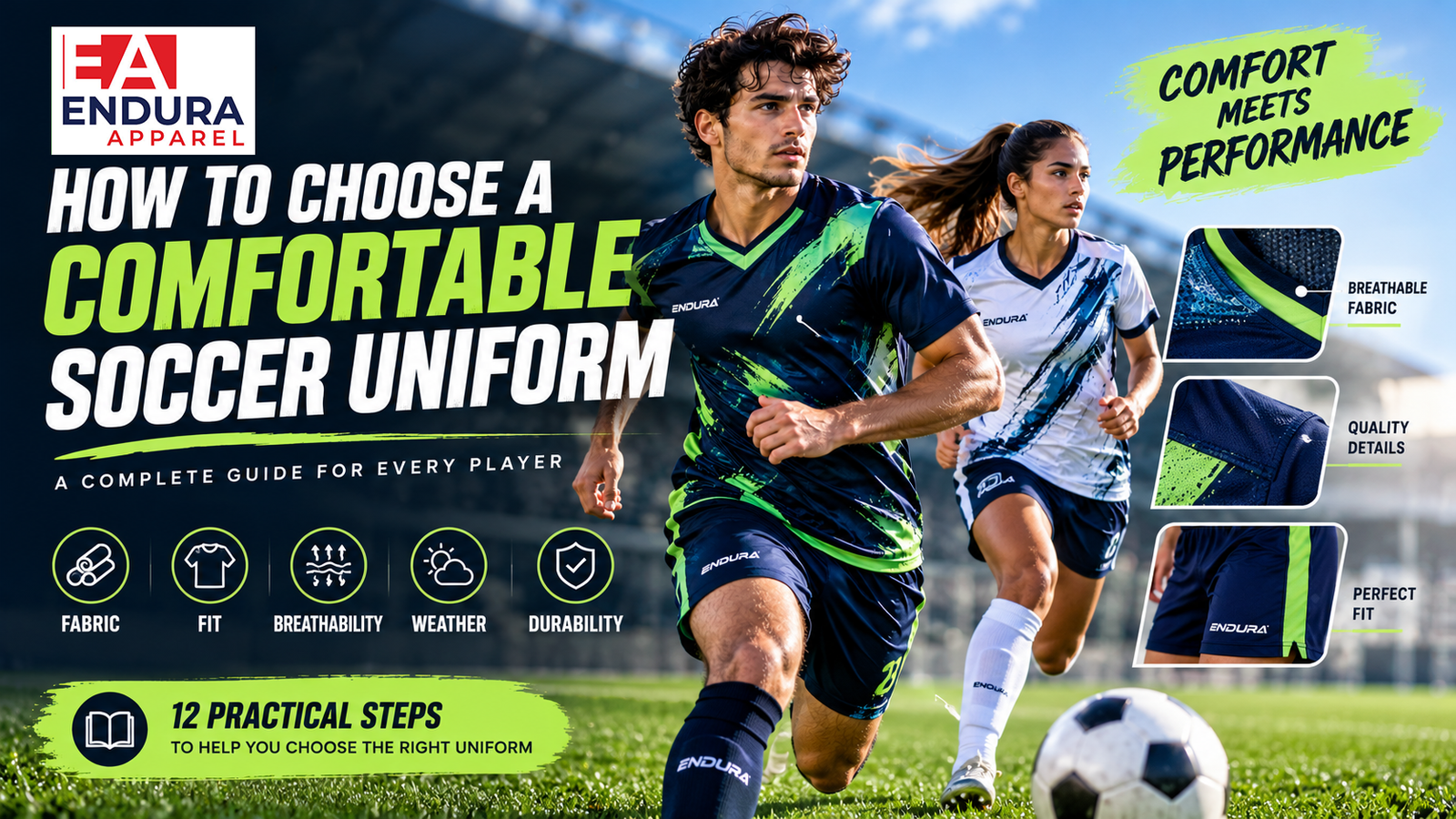
Introduction: Your Comfort Matters on the Pitch
Choosing comfortable soccer uniforms is essential for players who want to move freely, stay comfortable, and focus on their performance. Whether you play for a local club, school team, soccer academy, or competitive league, the right uniform should provide a comfortable fit, breathable fabric, and freedom of movement.
In this guide, we’ll explain how to select the right soccer jersey and shorts by considering fabric quality, sizing, ventilation, durability, and playing conditions.
1. Choose the Right Fabric for Your Soccer Uniform
Fabric is one of the most important factors when selecting a comfortable soccer uniform. The material affects how your jersey feels against your skin, how quickly it dries, and how comfortably you can move during a match.
Polyester: A Popular Choice for Soccer Jerseys
Polyester is widely used in modern soccer uniforms because it is lightweight, durable, and suitable for active sportswear.
Its main advantages include:
- Lightweight construction: Helps reduce the feeling of wearing heavy clothing.
- Quick drying: Polyester generally absorbs less moisture than cotton and can dry relatively quickly.
- Durability: Holds up well to repeated washing and regular use when properly manufactured.
- Color retention: Suitable for colorful designs, team logos, and sublimation printing.
- Easy maintenance: Generally practical for clubs and teams that wash uniforms frequently.
For players who train regularly or compete in multiple matches each week, polyester can be a practical choice.
However, not all polyester fabrics feel the same. Fabric construction, weight, ventilation, and finishing treatments can significantly affect comfort.
Dry-Fit and Moisture-Wicking Fabrics
You may have seen soccer jerseys advertised as Dry-Fit or moisture-wicking.
These terms generally refer to fabrics or fabric technologies designed to move moisture away from the skin, helping it spread across the material and evaporate.
The benefits can include:
- A drier feeling during intense activity.
- Reduced discomfort from sweat-soaked clothing.
- Better comfort during training and matches.
- A lightweight feel when the fabric is appropriately designed.
Remember that moisture-wicking performance depends on the specific fabric construction and finishing. The label alone does not guarantee superior performance.
Should You Choose Cotton for Soccer?
Cotton feels soft and comfortable for everyday wear, but it is generally less suitable for intensive soccer matches.
Cotton can absorb substantial amounts of sweat, making a jersey feel heavier and potentially cling to your body.
For competitive matches and demanding training sessions, lightweight sportswear fabrics are usually a more practical option.
Our recommendation: Look for lightweight polyester sportswear with good moisture management and ventilation. If possible, test the fabric before ordering uniforms for your entire team.
2. Find the Perfect Fit: Not Too Tight, Not Too Loose
Even a high-quality soccer jersey can feel uncomfortable if it doesn’t fit properly.
The right fit allows you to sprint, jump, kick, and turn without unnecessary restrictions.
Regular Fit
A regular-fit jersey offers a balanced combination of comfort and freedom of movement.
It is a good option for:
- Recreational players.
- School teams.
- Youth soccer academies.
- Players who prefer a relaxed feel.
Regular-fit jerseys are particularly useful when players prioritize everyday comfort over a close-fitting athletic appearance.
Slim Fit
Slim-fit soccer jerseys sit closer to the body.
They may appeal to players who prefer a streamlined athletic appearance and less excess fabric.
However, a slim fit should never restrict shoulder movement, arm rotation, breathing, or running.
If you feel pulling around your chest, shoulders, or underarms, consider a different size or cut.
Loose Fit
Some players prefer a slightly looser jersey because it feels less restrictive.
A relaxed fit can be comfortable for training and casual games, but excessive fabric may move around during play.
Choose a fit that allows natural movement without creating unnecessary bulk.
How Should Soccer Shorts Fit?
Your shorts deserve just as much attention as your jersey.
Comfortable soccer shorts should:
- Allow your hips and thighs to move freely.
- Provide sufficient room for sprinting and kicking.
- Have a comfortable waistband.
- Stay securely in place while running.
- Avoid excessive tightness around the thighs.
Before purchasing a complete kit, test the shorts by running, squatting, and performing a few kicking movements.
Quick tip:
When trying on a uniform, don’t simply stand in front of a mirror. Move as you would during a real match.
3. Prioritize Breathability and Ventilation
Soccer players can cover considerable distances during a match, often in warm conditions. Without adequate ventilation, heat and moisture can accumulate inside clothing.
A breathable soccer uniform helps support comfort by allowing heat and moisture vapor to escape.
What Should You Look For?
Consider these features when evaluating a jersey:
Mesh ventilation panels: Some jerseys incorporate mesh sections in areas where additional airflow may be beneficial.
Lightweight fabric construction: Lighter fabrics can feel less burdensome during extended activity, although weight alone does not determine breathability.
Moisture management: Fabrics that help spread sweat can support evaporation and improve the feeling of dryness.
Comfortable construction: Seams, collars, and sleeve openings should not cause unnecessary irritation.
For players in hot climates, including Pakistan, India, the Middle East, and parts of Africa, ventilation can be especially important.
However, even breathable sportswear cannot prevent overheating in extreme conditions. Players should also drink enough fluids, take appropriate breaks, and follow heat-safety guidance.
4. Select the Right Sleeve Style
Sleeve style is partly a matter of personal preference, but it can influence how a jersey feels during play.
Short-Sleeve Soccer Jerseys
Short sleeves are a popular choice for training and matches in warm weather.
They offer:
- Greater exposure of the arms to the air.
- Compatibility with most standard soccer kits.
- A familiar fit for many players.
- Plenty of options for custom team designs.
For players who train outdoors in hot conditions, short sleeves are often a practical starting point.
Long-Sleeve Soccer Jerseys
Long sleeves can be useful in cooler weather or when players prefer additional arm coverage.
Consider long-sleeve jerseys if you:
- Play in colder conditions.
- Train during winter evenings.
- Prefer more coverage.
- Need a uniform that works well with your team’s layering arrangements.
Choose sleeves that allow unrestricted arm movement without excessive fabric around the wrists.
What About Raglan Sleeves?
Raglan sleeves extend toward the neckline rather than attaching through a conventional shoulder seam.
This construction can offer a different shoulder fit and may improve freedom of movement, depending on the pattern and fabric.
Raglan jerseys are worth considering for custom soccer kits, particularly if your team prefers a distinctive athletic appearance.
The key is to evaluate the complete garment rather than assuming one sleeve construction is always more comfortable.
5. Consider the Weather and Playing Environment
The same soccer uniform may not feel equally comfortable in every climate.
Before selecting your kit, consider where and when you usually play.
Playing conditions
What to look for
Hot and humid weather
Lightweight fabric, effective moisture management, and good ventilation
Hot and humid weather
Breathable fabric, comfortable fit, and adequate hydration
Cool weather
Long sleeves or suitable layers that preserve movement
Rainy conditions
Fabric that does not become unnecessarily heavy and dries reasonably quickly
Indoor soccer
Lightweight construction and a fit that supports rapid movement
Frequent training
Durable fabric, comfortable seams, and easy-care materials
Should You Choose a Different Uniform for Training and Matches?
Not necessarily.
Many teams use the same basic fabric technology for both training and match uniforms.
However, training kits may prioritize affordability and durability, while match kits may emphasize appearance, custom graphics, and team identity.
If your budget allows, maintaining separate training and match kits can help reduce wear on your main uniforms.
6. Check the Seams, Collar, and Stitching
Fabric quality matters, but small construction details can also influence comfort.
A jersey may look impressive in photographs yet feel irritating after 30 minutes of running.
Pay attention to the following areas.
Seams
Look for smooth, secure stitching without loose threads or rough edges.
Seams around the shoulders, sides, and underarms should not rub excessively against your skin.
Collar
A collar should sit comfortably around your neck.
If it feels too tight, stiff, or abrasive, it may become distracting during a long match.
Sleeve Openings
Sleeves should provide enough room for natural arm movement without feeling excessively tight.
Labels and Printed Details
Rough labels, poorly positioned branding, and uncomfortable printed details can cause irritation.
If possible, choose garments with comfortable label construction and test any large internal print areas before ordering in bulk.
Remember: Good construction is about more than appearance. It should support comfort throughout repeated training sessions and matches.
7. Choose the Right Fabric Weight
Fabric weight is another factor worth considering when purchasing soccer uniforms.
It is often measured in grams per square metre (GSM).
Lightweight fabrics can be suitable for players who want a lighter feel, particularly in warm weather. However, the lowest GSM is not automatically the best choice.
Very lightweight fabric may be less durable or provide less coverage, depending on its construction.
Heavier fabric may offer a different feel and level of durability but can be less comfortable in hot conditions.
Which Fabric Weight Is Best?
There is no single ideal GSM for every player.
The right choice depends on:
- Climate and playing conditions.
- Fabric composition and construction.
- Desired durability.
- Transparency and coverage.
- Budget and intended use.
If you are ordering custom soccer uniforms, request fabric samples before approving a large production order.
Try the material on, move around in it, and evaluate how it feels during activity.
8. Make Sure Your Uniform Supports Your Playing Position
Your position does not determine the exact uniform you should wear, but your playing style may influence your preferences.
Forwards and Wingers
Players who frequently accelerate, change direction, and sprint may prefer lightweight jerseys and shorts that allow unrestricted movement.
A comfortable athletic fit can help minimize distracting excess fabric.
Midfielders
Midfielders often cover large distances throughout a match.
Breathability, moisture management, and overall comfort can be especially important for players who remain active for extended periods.
Defenders
Defenders need clothing that allows them to turn, jump, stretch, and move laterally.
Pay particular attention to shoulder comfort, shorts flexibility, and secure construction.
Goalkeepers
Goalkeepers may prefer different uniform features because their movements involve diving, stretching, and repeated contact with the ground.
Depending on the conditions and competition rules, goalkeeper kits may include long sleeves, protective padding, or other specialized features.
Regardless of position, the fundamental rule remains the same: your uniform should allow you to move naturally without unnecessary discomfort.
9. Choose Sublimation Printing for Custom Soccer Uniforms
Comfort is not the only consideration when purchasing a team uniform. Players and clubs also want attractive designs that represent their identity.
Custom sublimation printing is a popular option for polyester-based soccer uniforms.
In this process, heat transfers dye into the fabric, producing integrated graphics rather than a conventional thick layer of ink sitting on top of the material.
Why Do Teams Choose Sublimation?
Common advantages include:
- Extensive design and color options.
- Opportunities for custom patterns and gradients.
- Integration of team logos and player numbers.
- No need for a conventional thick printed layer over the sublimated areas.
- Consistent visual branding across a team’s kit.
Sublimation is particularly useful for clubs that want distinctive uniforms rather than generic designs.
However, the printing method does not automatically guarantee comfort. The underlying fabric, garment construction, and finishing quality still matter.
For the best result, choose a suitable fabric and work with a manufacturer that pays attention to both design and garment performance.
10. Don't Ignore Durability and Maintenance
A soccer uniform may feel excellent when new but lose its appeal if it stretches, fades, or develops uncomfortable seams after a few washes.
Before making your purchase, consider how frequently you play and how often the uniform will need washing.
Look for These Features
- Secure stitching.
- Fabric that retains its shape.
- Colorfast printing and dyeing.
- Comfortable construction after washing.
- Practical care instructions.
How to Maintain Your Soccer Uniform
Follow the garment’s care label, but these general practices can help:
- Wash uniforms after use when practical.
- Use a suitable detergent.
- Avoid excessive heat during washing and drying.
- Turn printed garments inside out if recommended by the manufacturer.
- Avoid ironing directly over printed areas unless the care instructions permit it.
- Allow uniforms to dry thoroughly before storing them.
Proper maintenance can help extend the useful life of your sportswear.
11. How to Choose the Right Size When Ordering Online
Buying soccer uniforms online is convenient, but choosing the wrong size can lead to unnecessary discomfort and replacement costs.
This is especially important when ordering custom kits for an entire club.
Follow These Steps
Step 1: Check the size chart.
Don’t assume that a medium in one brand will fit like a medium in another.
Step 2: Measure your body.
Use the manufacturer’s instructions to measure your chest, waist, hips, and other relevant dimensions.
Step 3: Compare your measurements.
Select the size that corresponds to the manufacturer’s chart and consider the intended fit.
Step 4: Review the garment measurements.
If available, compare the jersey’s chest width, body length, and sleeve length with a uniform you already find comfortable.
Step 5: Confirm the fit before bulk production.
For clubs and academies, request a sample or size set where possible.
Step 6: Account for different players.
A youth team may need a different size range from an adult team. Avoid ordering every uniform in the same cut or size simply for convenience.
What If You're Between Two Sizes?
The answer depends on the manufacturer’s sizing and your preferred fit.
If you prefer a relaxed fit, the larger size may be more comfortable. If you prefer a closer fit, the smaller size may work, provided it does not restrict movement.
Always check the actual measurements rather than relying on a general rule.
12. A Quick Checklist Before Buying Your Soccer Uniform
Before placing an order, ask yourself these questions:
- Is the fabric lightweight and comfortable?
- Does it offer suitable breathability and moisture management?
- Can I sprint, kick, jump, and turn without restrictions?
- Do the jersey and shorts fit properly?
- Are the seams and collar comfortable?
- Is the fabric appropriate for my local climate?
- Does the uniform provide adequate coverage?
- Is the construction durable enough for regular use?
- Can I maintain it without special difficulty?
- If I’m ordering online, have I checked the size chart?
- If I’m ordering for a team, can I review a sample before bulk production?
If you can confidently answer these questions, you’re much more likely to select a uniform that meets your needs.
13. Why Custom Soccer Uniforms Can Be a Better Choice for Teams
For individual players, comfort and fit are the main priorities. For clubs, academies, and sports organizations, consistency and team identity matter too.
Custom soccer uniforms allow teams to select designs, colors, player names, numbers, and branding that reflect their identity.
When choosing a custom uniform manufacturer, consider more than the appearance of its designs.
Ask about:
- Fabric composition and weight.
- Available sizing and fit options.
- Sublimation and other printing methods.
- Embroidery options where appropriate.
- Sample availability.
- Production timelines.
- Minimum order quantities.
- Quality control and replacement policies.
A manufacturer that understands your requirements can help you balance comfort, appearance, durability, and budget.
For teams ordering multiple uniforms, requesting a sample before approving the complete order is a sensible way to reduce uncertainty.
Conclusion: The Right Soccer Uniform Starts With Comfort
Choosing the right soccer uniform doesn’t have to be complicated.
Start with a fabric that suits your playing conditions. Find a fit that allows natural movement. Look for appropriate ventilation, comfortable seams, and durable construction. Finally, confirm the size before placing your order.
Whether you’re a beginner, a regular player, a goalkeeper, or a member of a competitive club, your uniform should help you concentrate on the game rather than what you’re wearing.
Choose comfort first. Choose quality second. Let your team’s identity complete the look.
When your soccer uniform feels right, you can focus on what matters most: enjoying the game, working with your teammates, and giving your best performance on the pitch.
Looking for Custom Soccer Uniforms for Your Team?
At Endura Apparel, we help soccer clubs, academies, teams, and sportswear businesses bring their uniform ideas to life.
From custom colors and team logos to player names, numbers, and sublimated designs, our goal is to help teams create sportswear that reflects their identity.
Whether you’re planning a new season, launching a soccer academy, or refreshing your club’s look, choosing the right fabric and fit is an important first step.
Ready to discuss your next soccer uniform project?